

You can’t consume your way out of AI Cost Opacity
You can’t consume your way out of AI Cost Opacity
Palantir’s government AI momentum is real. So are the contract, budget, and tokenization risks no one should ignore.
Martin Jennings, General Manager, Product Group, Permuta Technologies
16 Jun 2026
Executive Summary
Artificial intelligence adoption inside the government market is increasingly shifting from experimentation to operational deployment. As that shift occurs, the pricing model behind AI is also changing. Flat subscription assumptions are giving way to hybrid billing structures tied to token consumption, compute utilization, platform access, and variable model selection. The impact of these changes was recently highlighted when Microsoft changed its AI pricing to align with the industry trend of transitioning away from subscription models toward tokenization (GitHub Copilot Token Usage Pricing Change Reaction). This pricing transition matters because it changes AI from a predictable software line item into an ungoverned and dynamic operating cost that can vary greatly as usage expands across an organization’s user base.
Palantir is one of the most important companies to analyze within this shift because its government business is already large, mission-facing, and deeply embedded in defense, health, and intelligence environments. Palantir’s 2024 annual report states that 55% of total revenue came from government customers, and the company continues to position itself for expanded U.S. Federal software spending. Its public contract footprint includes major operational programs such as the Department of Defense Maven Smart System, the Department of Health and Human Services BPA, NHS England’s Federated Data Platform, and intelligence-related work in allied governments.
The issue is not simply that Palantir uses AI. The more important issue is that Palantir’s own Artificial Intelligence Platform (AIP) documentation shows that model interactions are measured through tokens, translated into compute-seconds to reflect the pricing of the underlying model provider, and exportable by model, application, resource, and currency. That means the market-wide shift toward tokenized and consumption-based AI billing is not theoretical in Palantir’s case. It is already present in the architecture that underlies Palantir’s AI-enabled offering set.
This paper examines how those tokenization mechanics can affect the economics of Palantir’s existing government contracts. It argues that as Palantir programs scale across users, missions, and workflows, AI usage can become a meaningful driver of marginal cost, contract ceiling pressure, and oversight burden. The result is that agencies may face growing exposure to variable AI costs inside contracts that were initially understood primarily as platform procurements.
The central conclusion is that Palantir’s government contract momentum and the industry’s tokenization trend are converging in a way that demands closer scrutiny from acquisition leaders, budget officials, and program managers. The key procurement question is no longer limited to whether Palantir’s software delivers mission value. It is whether Government buyers can maintain cost transparency and contractual control once unfettered AI usage in the hands of end users becomes operationally indispensable.
Introduction
The first paper in this Permuta Technologies series, You can’t prompt your way out of Enterprise Complexity, argued that AI enthusiasm often outruns the economic, architectural, and governance realities of enterprise deployment. That argument applies with particular force to Palantir because Palantir sits at the intersection of secure mission software, operational AI, and large public-sector contracts.
Palantir is not a generic developer tool vendor. It operates in environments where customers care about data fusion, decision support, workflow orchestration, auditability, security controls, and operational continuity. Those characteristics make Palantir valuable in government settings, but they also make the economics of AI usage harder to simplify. Once AI functionality is embedded into operational workflows, cost no longer scales only with licenses or labor. It can also scale with prompt size, response size, model selection, concurrency, retrieval, and agent activity.
This creates a practical policy problem. Government buyers are accustomed to evaluating software through fixed licenses, subscriptions, labor rates, and contract ceilings. Tokenization changes that logic by introducing a variable usage layer that may not be obvious from the headline value of the contract itself.
Palantir’s Government Position
Palantir’s annual report describes the company as having been founded to build software for the U.S. intelligence community, and that history remains central to how the company positions itself today. The same filing states that AIP is bundled with Foundry, Gotham, and Apollo and is designed to enable responsible artificial intelligence across government and enterprise environments.
That positioning matters because Palantir is not selling isolated model access. It is selling an operating environment in which data, workflows, security controls, and LLM-backed functions are connected inside a mission system. This is a materially different economic structure from a simple software subscription because model-backed interactions can become embedded throughout the workflow stack.
Palantir’s contract pattern reinforces this point. Its public-sector work spans defense, health, transportation, and allied intelligence relationships, and several awards show that once adoption begins, enterprise expansion can follow. The most visible example is Maven Smart System, where Palantir’s initial five-year, $480 million contract was later expanded by $795 million due to growing demand, bringing the ceiling to nearly $1.3 billion through 2029.
Why Tokenization Matters
Palantir’s AIP documentation provides direct evidence that tokenization is built into the company’s AI cost model. Palantir states that prompts and responses consume tokens, that those tokens are converted into compute-seconds to reflect the cost of the backing model provider, and that usage data can be exported by application, model, resource, compute-seconds, and currency. It also states that usage can arise across multiple product surfaces, including AIP Assist, AIP Logic, Code Assist, Workshop tools, Quiver tools, Pipeline Builder tools, and direct Language Model Service calls.
This means cost expansion inside Palantir deployments can occur through several mechanisms. Larger prompts consume more tokens. Longer outputs consume more tokens. More users create more interactions. More agentic workflows create more model calls. More demanding mission use cases may require more capable and more expensive models. In short, Palantir’s AI economics are usage-sensitive by design.
This is where the broader market shift from VC-subsidized AI pricing to cost-realistic billing becomes relevant. During the early adoption period, many AI vendors could underprice access to accelerate growth and normalize consumption. As model costs, infrastructure demands, and investor expectations become harder to subsidize, vendors are under pressure to recover real cost through variable or hybrid billing. Palantir’s documentation suggests that it has already built the telemetry and accounting structure necessary for that transition.
The Hidden Cost Problem
The same dynamic described in the first Permuta paper also appears here in a more contract-specific form. AI value is often marketed through productivity outcomes, but the underlying economic model may depend on token usage, model tier, orchestration complexity, and continued infrastructure spend that are not obvious in topline pricing.
For Palantir customers, that hidden-cost problem is amplified by mission conditions. Government programs do not operate in a vacuum. They experience crisis surges, operational spikes, evolving user communities, and expanding workflow demands. The moments when agencies most rely on AI may also be the moments when usage costs accelerate the fastest.
This creates at least five practical risks for government buyers:
-
Budget unpredictability, because usage may scale with mission tempo rather than planned seat counts.
-
Reduced cost transparency, because platform value and model-consumption cost can become intertwined.
-
Ceiling pressure, because successful operational adoption can increase obligations faster than expected.
-
Source-selection difficulty, because competing offers may structure AI pricing through very different mixes of license, subscription, metering, and cloud pass-through.
-
Lock-in risk, because workflows, governance, attribution, and operational habit may all converge inside one vendor environment.
Toward a Better Contract Model
The lesson is not that Palantir should be avoided. The lesson is that Palantir contracts involving AI-enabled workflows should be evaluated with more economic precision than many public-sector software buys historically required.
A more defensible acquisition posture would separate fixed platform and governance costs from variable model-consumption costs, require usage reporting at a level that supports agency chargeback and audit, and establish ceiling protections or tiering rules for surge scenarios. It would also force acquisition teams to evaluate mission value against the full operating cost of AI, not merely the initial access price or productivity claim.
In the same way that the first white paper argued that leaders cannot prompt their way out of enterprise complexity, this paper argues that agencies cannot consume their way out of AI cost opacity. If tokenization remains poorly governed, then even successful Palantir deployments may become economically harder to explain, budget, and compete over time.
Permuta’s Contrasting Approach
A useful contrast to Palantir’s contract and pricing posture is Permuta’s own approach to mission software and AI enablement. Permuta’s DefenseReady is a Commercial Off-The-Shelf readiness platform built on Microsoft Dynamics 365 and the Microsoft Power Platform, designed to give defense and government customers an integrated view across workforce, training, medical, assets, security, budget, mission, and workflow functions.
That architecture matters because Permuta is not positioning AI as the foundation of the platform. It is positioning AI as an optional extension on top of an already mature mission system. Permuta’s recent Memorial Day 2026 platform update states that DefenseReady is built on Microsoft Power Platform and Dynamics 365, is deployed across IaaS IL5/6, SaaS IL5, and on-premises environments, and ships its AI capabilities disabled by default. The configuration guide similarly describes AIReady as a metadata framework that prepares DefenseReady data for AI workloads while preserving bring-your-own-model flexibility and avoiding costly vector-search-heavy architectures where they are not required.
This is a meaningful difference from the market’s more consumption-forward AI story. Palantir’s public AIP documentation shows that model interaction is a meterable layer inside the product environment, translated into compute-seconds and attributed by application, model, and currency. Permuta’s model, by contrast, is structured to let customers control whether AI is enabled at all, which model endpoint is used, and whether that endpoint lives in Azure OpenAI, OpenAI-compatible on-premises runtimes, Ollama, or other approved Government first AI environments such as Ask Sage or GenAI.mil.
Why Permuta Is Different
Permuta’s Readiness Platform offerings have five substantive differences that are worth highlighting in contrast to Palantir:
-
Mission platform first, AI second. DefenseReady is presented as a mature readiness platform with established workflows and modules, not as an AI-first product searching for operational use cases after deployment.
-
Customer-controlled model choice. DefenseReady allows customers to bring their own model and swap providers without rewriting application logic, which can reduce dependency on a single commercial AI stack.
-
Security posture by deployment type. Permuta’s AI guidance distinguishes between cloud, government cloud, self-hosted, air-gapped, and on-premises patterns, with controls such as private endpoints, managed identities, IAM roles, secret managers, and disabled-by-default feature activation.
-
Cost discipline by design. Permuta’s AI roadmap and configuration guidance intentionally avoid forcing every customer into the most infrastructure-intensive AI path. Level 1 AI focuses on metadata-driven experts and conversational assistance, while higher-complexity reasoning and agentic patterns are staged later and tied to more deliberate maturity requirements.
-
Engineering realism. Permuta’s own white papers and internal messaging do not claim that AI replaces disciplined software engineering. They explicitly frame AI as a force multiplier, caution against hype, and state that pure code-generation approaches were not adopted for core product development because of complexity, security, and rework concerns.
This last point is especially important for the contrast. In recent press releases to their customers and partners, Permuta highlighted that while they use AI tools such as GitHub Copilot, Microsoft Copilot, and a handful of other AI capabilities as force multipliers across the development lifecycle, they do not use pure code-generation AI for core product development because the resulting code requires more rework than manual changes at current AI tool maturity levels when applied to large scale enterprise solutions such as their Readiness Platform. That development posture supports a different AI story than the one often sold by token-driven AI vendors. Rather than arguing that AI will replace the need for disciplined architecture, Permuta’s documents argue that architecture, accreditation history, tested workflows, and training infrastructure are the things that make selective AI adoption viable in the first place. The result is a more incremental, controlled, and operationally legible adoption path, particularly for defense customers that must preserve continuity, accreditation, and auditability. This is a materially more conservative and operationally grounded position than the broader AI market narrative that assumes AI-generated capability automatically translates into lower total cost.
Architectural And Economic Contrast
The strongest contrast between Palantir and Permuta is not simply that one uses more AI than the other. The stronger contrast is where each company places AI in the system architecture and commercial model.
Palantir’s public materials indicate that AI consumption can become an operating layer embedded within the mission platform itself, creating a path where increased mission reliance can translate into increased usage-sensitive cost. Permuta’s architecture, by contrast, appears designed to keep the mission platform stable while letting the AI layer remain modular, configurable, and in some cases removable or disabled without disrupting the baseline application environment.
That difference has procurement implications. If AI is deeply fused into the commercial and operational core, then usage growth can become hard to isolate from platform value. If AI is modular, disabled by default, and customer-routable to approved endpoints, then agencies may retain more control over cost, hosting model, data handling, and transition strategy. This does not eliminate variable AI cost, but it can improve bargaining power and reduce the degree to which model-consumption economics are hidden inside a larger enterprise platform story.
What This Means for Buyers
For acquisition leaders, the contrast between Palantir and Permuta is not a simple good-versus-bad comparison. Palantir appears optimized for high-scale operational AI and decision support in environments where rapid AI expansion can justify larger contract ceilings. Permuta appears optimized for mission software continuity, Commercial Off-the-Shelf (COTS)-based readiness workflows, and a more controlled AI-enablement path that preserves customer control over hosting, activation, and model choice.
That means the better fit depends on the problem being solved. If the customer wants an AI-forward operational environment where model-backed workflows are central to mission execution, Palantir’s posture may be attractive, but buyers should expect more scrutiny around consumption, scaling, and hidden cost behavior. If the customer wants to add AI to an existing readiness and workforce management operating model without surrendering architectural control or forcing immediate AI dependency, Permuta’s approach may offer a more fiscally legible and operationally conservative path.
Third-Party Market Assessment
A useful additional contrast comes from Hawkins Group’s December 2025 third-party industry comparison, which evaluated Permuta relative to competitors using perceptual mapping and Strengths, Weaknesses, Opportunities, and Threats (SWOT) analysis focused on total cost of ownership and advanced Human Capital Management (HCM)/Work Force Management (WFM) capabilities. That assessment concluded that Permuta sat in the low-cost, high-capability quadrant, while Palantir sat in a high-cost, moderate-capability position for this specific workforce and readiness problem space.
That third-party framing strengthens the distinction already developed in this paper. Hawkins Group characterized Permuta’s value around lower total cost of ownership, strong workforce and readiness foundations, Microsoft ecosystem integration, and established relevance in Federal and DoD environments. It characterized Palantir as expensive and potentially able to accelerate HCM and workforce-management delivery, but still as a higher-cost option with more moderate native fit for this mission set.
The appendix-level competitor matrix in the Hawkins Group analysis is even more direct. It describes Palantir as a data analytics platform rather than a system built for Human Resource (HR) or workforce execution, notes that it requires custom modeling and engineering teams, lacks native support for DoD 8140, clearance workflows, or DoD HR standards, and carries high total cost of ownership because of software plus heavy services. By contrast, the same matrix describes Permuta as mission-driven, faster to deploy through mission templates, lower in Total Cost of Ownership (TCO) under a COTS model, and stronger in native support for DoD-specific functions such as billet tracking, Personnel Tempo (PERSTEMPO), readiness dashboards, congressional reporting, and integrations with systems such as Defense Information System for Security (DISS) and the Defense Civilian Payroll System (DCPS).
Conclusion
Palantir is a useful case study because it shows how quickly AI economics can move from technical abstraction to procurement reality. The company’s public disclosures show a government-heavy revenue mix and a product portfolio built to operationalize AI in sensitive environments. Its AIP documentation shows that tokenized usage is already measurable and attributable. Its contract history shows that successful programs can expand materially as adoption grows.
Taken together, those facts support a simple conclusion. The next phase of AI oversight in government will not be defined only by model performance or mission utility. It will also be defined by whether agencies can understand and control the cost behavior of AI once usage becomes embedded in mission workflows.
For acquisition leaders and senior decision makers, the strategic issue is no longer whether Palantir can deliver AI-enabled capability. The more important question is whether the contract structure makes the long-run cost of that capability visible before dependence makes renegotiation difficult.
About the Author

Martin “Marty” Jennings, Colonel (retired), United States Air Force
General Manager, Product Group, Permuta Technologies
For the past 3 years, Marty Jennings has been the General Manager for the Product Group at Permuta Technologies, where he leads a team of Microsoft-certified developers responsible for more than 400 applications supporting unique Federal and Military use cases worldwide. Prior to joining Permuta, he served as Chief Cloud Architect and Chief Engineer for Leidos’ 10-year, $10B GSM-O II contract with the Defense Information Systems Agency (DISA). A 30-year U.S. Air Force veteran, Marty retired in the rank of Colonel in September 2021. His military and civilian career spans software development, cybersecurity, and large-scale enterprise system program management in support of multiple combatant commands and agencies.

You can’t prompt your way out of Enterprise Complexity
You can’t prompt your way out of Enterprise Complexity
AI Vibe coding hype is real. So are the constraints no one is discussing.
Martin Jennings, General Manager, Product Group, Permuta Technologies
17 Mar 2026
Executive Summary
Artificial intelligence-assisted software development has emerged as one of the most widely discussed disruptive technological innovations in the modern software industry. Tools such as GitHub Copilot, Claude Code, Cursor, and similar systems are designed to generate code, tests, documentation, and system scaffolding from natural language prompts. These systems promise to significantly increase developer productivity and potentially reduce manpower requirements in software engineering organizations.
In the commercial technology sector, AI-assisted coding has quickly moved from experimental tooling to everyday development infrastructure. Major technology firms report that a meaningful percentage of their code is now produced with AI assistance. These developments have led to widespread speculation that software engineering workforces may shrink substantially as automated development tools mature.
However, the narrative surrounding AI-generated code has increasingly taken on the characteristics of a technology hype cycle. Public discussion frequently emphasizes developer productivity and manpower reduction while overlooking structural limitations, long-term maintenance costs, and operational risks. In a nutshell the hype has been focused on one aspect of the decision-making equation, manpower savings, without truly factoring all the variables that will bound and, in many cases, limit the value of a wholesale shift to AI-assisted development. Further, these nascent value calculations are based on imperfect cost data that are highly subsidized by venture capital.
These limitations are particularly important for the United States Federal Government and Department of Defense. Government systems frequently operate in secure environments, rely on large monolithic enterprise codebases, and must satisfy strict compliance, traceability, and security requirements. Many mission-critical systems operate on enterprise server stacks that must be included when making architectural design decisions. For example, Permuta leverages Microsoft Dynamics, SQL Server, and Windows Server as a platform for on-Premises solutions and the Azure Power Platform for SaaS deployments. We don’t have access to Microsoft’s underlying code base to refactor it using AI-assisted development, nor would we want to. Microsoft has spent decades developing standards-based platform solutions that not only provide reliable and secure infrastructure but also bulk licensing discounts. The same can be said for solutions built on top of Salesforce, Palantir, and other Enterprise solution providers.
Within the Defense Industrial Base, contractors and companies supporting the Federal Government and Department of War, the promise of rapid AI-generated development faces several constraints. These include context window limitations in large language models, security vulnerabilities in generated code, architectural inconsistency, hidden operational costs associated with token consumption and licensing, and significant governance challenges.
This paper examines the current state of AI-assisted vibe coding, analyzes the technology hype cycle surrounding automated development, and evaluates the barriers to adoption within federal and defense environments. It also explores economic and political considerations related to workforce impacts, congressional oversight, and the redistribution of government spending toward private technology vendors.
The central conclusion is that AI-assisted coding will likely become an important productivity tool for developers, but it cannot replace disciplined engineering processes in large, secure, and long-lived government software systems. Further, when senior decision makers are faced with proposals that claim AI-assisted coding-related savings that feel “too good to be true” they probably don’t factor all the costs associated with a shift of this magnitude. The proposed evaluation equation at the end of this paper will help those senior leaders factor all the variables to ensure a true “apples to apples” cost comparison when deciding on AI-assisted coding tradeoffs and anticipated savings.
Introduction
Large language models capable of generating executable code have introduced a new paradigm in software development. In this paradigm developers interact conversationally with AI systems that generate software components based on natural language prompts. This workflow is often referred to informally as “AI vibe coding.” The developer describes the intent of a feature and the AI system produces a working implementation which is then refined and integrated into the broader system. In small development environments or early-stage startups this approach can significantly accelerate prototyping and early product development.
Federal enterprise software environments present a fundamentally different context. Government applications frequently operate within extremely large codebases developed over decades. These systems often contain millions of lines of code spanning multiple services, integration layers, and regulatory compliance frameworks. Many federal enterprise systems rely heavily on Microsoft or other enterprise server stacks. In Permuta’s case, we have been writing code on top of the Microsoft stack for over 26 years. Our Readiness Platform family of solutions relies on this certified, accredited, and professionally supported infrastructure to provide assured secure, reliable and scalable solutions to the Department of War, Federal, State and Local Government and Higher Education sectors.
The enterprise scale environments we operate in frequently include C# service layers, TypeScript web front ends, Microsoft SQL Server data tiers, on-premises Dynamics deployments, and hybrid integration with Azure Power Platform.
Such systems are not easily restructured or replaced. They represent long-lived infrastructure that must remain secure, maintainable, and operational for decades. In this environment the introduction of AI-generated development raises strategic questions for policymakers and technology leaders regarding security, architecture, workforce impact, and long-term program sustainability.
The AI Development Hype Cycle
The emergence of AI vibe coding tools closely follows the pattern described by the Gartner Hype Cycle. New technologies typically move through phases beginning with an innovation trigger followed by a rapid increase in public attention and expectations. This phase of inflated expectations is characterized by highly visible success stories and aggressive projections about the technology‘s future impact.
As organizations begin deploying the technology in complex real-world environments the limitations of the technology become clearer. This phase is commonly referred to as the trough of disillusionment. Over time practical use cases emerge and the technology eventually reaches a stable plateau of productivity.
AI vibe coding currently appears to be near the “peak of inflated expectations” heading downward toward the “trough of disillusionment.” Public discourse frequently focuses on claims that AI systems will dramatically reduce software engineering staff or enable organizations to build complex enterprise systems with minimal human oversight. These narratives often overlook the realities of enterprise software development where architectural governance, security requirements, and long-term maintainability dominate engineering effort. Government systems represent an extreme example of this complexity.
Structural Constraints in Federal Software Systems
Enterprise government systems frequently contain millions of lines of code and incorporate multiple generations of architecture. These systems must integrate with legacy platforms, comply with regulatory frameworks, and maintain compatibility with operational environments that may persist for decades. Large language models operate with limited context windows that restrict the amount of source code they can analyze at one time. As a result, AI systems often lack the architectural awareness required to make consistent modifications across large codebases. When applied to monolithic systems, this limitation can lead to duplicated logic, inconsistent patterns, and architectural drift.
Security considerations introduce additional challenges. Government systems must comply with strict frameworks including the NIST Risk Management Framework, FedRAMP requirements, and Department of Defense secure development standards. AI-generated code has been shown in multiple studies to introduce security vulnerabilities at a higher rate than human-written code. These vulnerabilities frequently involve improper input validation, insecure authentication logic, and unsafe handling of sensitive data. Although these vulnerabilities can be mitigated through testing and review, they increase the burden placed on security teams and reduce the productivity benefits promised by automated development.
Architectural governance also becomes more difficult when code is generated dynamically through prompt-driven workflows. Enterprise systems rely on consistent architectural patterns to remain maintainable over long periods of time. When AI-generated components bypass these patterns the result can be increased technical debt and long-term maintenance costs.
Case Studies of AI Generated Code Failures
Several recent studies have demonstrated the security and reliability challenges associated with AI generated code. Research conducted by academic institutions and industry security groups has found that large language models frequently generate code containing common vulnerabilities including injection attacks, insecure authentication patterns, and improper data validation. Reports from the National Institute of Standards and Technology have emphasized the importance of rigorous testing and verification when using generative AI within software engineering environments. Defense organizations have similarly highlighted the importance of secure development practices within AI assisted workflows.
System Complexity and Productivity
Enterprise government systems often contain millions of lines of code and integrate with numerous legacy systems. As system complexity increases the ability of AI tools to reason about architecture decreases. Productivity improvements therefore tend to decline as system complexity grows.
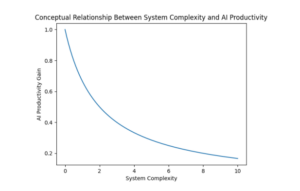
According to Danial Braz, “AI does not simplify Architecture. It Exposes it… When AI is layered onto a weak architecture, it usually does not create new categories of dysfunction out of nowhere. It accelerates existing ones.” This is why the architectures associated with monolithic and complex enterprise systems cannot be shifted to AI orchestrated development and support in a wholesale manner without significant risk to the end customer’s data or mission. The reality is AI vibe coding just doesn’t scale in a linear fashion, especially in support of the Federal Government.
Hidden Operational Costs of AI Development
The discussion surrounding AI-assisted coding frequently focuses on potential labor savings. However, the operational cost structure associated with AI-generated development is often overlooked. Many AI development platforms operate on usage-based pricing models tied to token consumption and compute utilization. As organizations scale AI-assisted development these costs can increase substantially. Large monolithic systems exacerbate this problem because prompts must include larger volumes of context in order to produce meaningful code generation. This results in increased inference costs and higher token consumption.
Additional costs arise from the need to verify AI-generated code. AI generated development in these environments must navigate complex architectural boundaries including custom plugins, workflow automation, security roles, data governance policies, and legacy integration layers. These constraints significantly limit the ability of automated tools to modify systems without careful architectural oversight. Even when generated code appears correct it must still undergo security testing, compliance validation, integration testing, and code review. Testing costs may actually increase in some cases because developers must carefully validate code that they did not write themselves. Maintenance costs also become a significant factor if AI-generated code introduces inconsistencies in architecture or documentation.
The Subsidy Reality
Even considering the costs discussed above may not be enough to make a strategic decision. Many of the subscription and consumption costs behind the AI solutions and infrastructure required are currently propped up by heavy subsidies. As Claude Ciocan pointed out in a recent article, “For developers and founders building AI-powered products, this creates a dangerous foundation. Your unit economics might work beautifully today, but they’re built on sand. When the subsidy era ends (and it will) the companies that survive will be the ones that saw it coming.” According to the CEO of Perplexity, venture capital is propping up the layers of companies, solutions, and infrastructure or “wrappers” on top of the underlying power grid and data center compute costs that form the foundation of these AI tools. The venture capitalists are hoping their “wrapper” captures enough market share and becomes sticky enough to become profitable in the future. This venture capital-backed AI bubble has the potential to pop resulting in significant price increases that could impact the viability of any business cases that involve wholesale replacement of human coders or significant shifts to reliance on these AI-assisted coding tools.
Institutional Barriers to Adoption
Technical and cost considerations represent only part of the challenge associated with AI-assisted development in government environments. Federal institutions operate within complex bureaucratic and political frameworks that influence technology adoption decisions. Government systems frequently support distributed workforces located across multiple states. Federal software programs often provide stable employment opportunities in regions that may have limited access to high-technology industries.
A shift toward AI-driven development that concentrates spending on a small number of technology vendors located primarily in Silicon Valley, Austin, and other AI-incubating cities could face substantial congressional scrutiny. Legislators are often reluctant to support policies that redirect federal spending away from their districts toward a concentrated group of technology companies.
Workforce considerations are particularly significant within the Department of War. Many military systems rely heavily on human expertise and operational judgment. In many cases the effectiveness of the weapon system is directly tied to the people operating and maintaining it. Proposals that focus exclusively on manpower reduction can therefore conflict with operational realities and institutional priorities. These political and organizational constraints mean that even if AI-assisted development offers productivity improvements, it may not translate directly into workforce reductions.
Any solution that’s proposed savings are tied to reductions in military or civilian workforce should be treated with a great deal of suspicion. In my 30 years of service in the United States Air Force and the 5 years since, I had the opportunity to deliver enterprise software solutions at scale, run programs that implemented or addressed disruptive technologies. Without exception the single issue that resulted in a project’s failure was projecting significant cost savings based purely on workforce reductions.
The Department of War is a collection of Services that derive their power in warfighting projection from a combination of military and civilian resources that comprise their wartime and peacetime workforces and in many cases weapon systems. The peacetime exercise of this weapon system through centralized control and decentralized execution requires a series of what often seems like inefficient communication or what many call bureaucracy. In reality it is a time-tested solution that minimizes complexity and training while maximizing effects and flexibility. Unfortunately, many look at this situation as inefficient and target it for automation or as an opportunity to save money without looking at the big picture.
Furthermore, Congress has a vested interest in maintaining the military and civilian workforce in a distributed manner across the United States in financially isolated regions. This distributed network of military bases redistributes taxpayer dollars to areas that would otherwise be underrepresented. This combined with the above highlighted shift in AI-related revenue away from these congressional districts adds further congressional interest and risk to any AI-related disruptive technology that’s viability hinges on workforce reductions alone and must be considered when making decisions about AI technology adoption and tradeoffs.
Toward a Quantitative Decision Framework
I am not saying that this disruptive technology has no place in today’s software development world. Quite the opposite. I believe there are significant benefits to adopting these technologies to assist in development to drive innovation and productivity. I am just highlighting the fact that there is a significant amount of risk and variables to consider when making decisions about future expenditures tied to AI-assisted coding efforts.
Given the technical complexity and institutional realities described above, government organizations require a structured framework for evaluating the potential benefits of AI-assisted development. Most discussions of AI productivity focus on labor savings alone. This perspective fails to account for the numerous operational costs and organizational constraints that accompany the introduction of automated development tools. A more realistic approach is to evaluate AI-assisted development as a ratio between measurable benefits and the total cost and complexity introduced by the technology. The benefits of AI-assisted development generally fall into three categories:
-
The first category involves reductions in developer labor associated with code generation and debugging.
-
The second category involves improvements in development velocity that allow capabilities to be delivered more quickly.
-
The third category involves reductions in development cycle time that may accelerate program delivery.
Against these benefits must be weighed a broad set of costs that include software licensing, token consumption, testing overhead, maintenance complexity, architectural degradation, security risk, and governance requirements. In addition to these technical costs, government organizations must also consider political and institutional constraints related to workforce distribution and congressional oversight. Evaluating AI assisted development requires balancing potential productivity gains against operational costs and institutional constraints. A decision framework can be constructed that compares the expected benefits of automation with the combined technical, economic, and political costs associated with the technology.
Conclusion: The AI Development Decision Formula
The analysis presented in this paper leads to a decision framework that captures the balance between productivity gains and the full range of costs and barriers associated with AI-assisted development. The return on investment for AI-assisted development can be represented as the ratio between productivity benefits and the combined operational and institutional costs introduced by the technology. If that ratio results in a value of 1 or higher, then the savings outweigh the costs, and the effort should be considered viable based on a current understanding of all variables considered.
In simplified form the relationship can be expressed as:
In practice this equation must also incorporate a complexity multiplier that reflects the scale and integration requirements of the system being analyzed. Large government codebases significantly increase the operational cost associated with AI-generated development due to architectural complexity and security requirements.
The expanded decision formula therefore becomes:
This framework highlights a key strategic insight. AI coding tools primarily function as productivity amplifiers for developers rather than replacements for engineering teams. In environments characterized by large monolithic systems, strict security requirements, and distributed workforces, the complexity multiplier and institutional constraints often offset the manpower savings predicted by AI vendors. For this reason, government and defense organizations should approach AI-assisted development as a capability that augments human expertise rather than replacing it. Organizations that adopt this balanced perspective will be best positioned to capture the benefits of AI-assisted development while preserving the reliability, security, and accountability required in mission-critical federal systems.
About the Author
Martin “Marty” Jennings, Colonel (retired), United States Air Force
General Manager, Product Group, Permuta Technologies
LinkedIn: https://www.linkedin.com/in/jentek
For the past 3 years, Marty Jennings has been the General Manager for the Product Group at Permuta Technologies, where he leads a team of Microsoft-certified developers responsible for more than 400 applications supporting unique Federal and Military use cases worldwide. Prior to joining Permuta, he served as Chief Cloud Architect and Chief Engineer for Leidos’ 10-year, $10B GSM-O II contract with the Defense Information Systems Agency (DISA). A 30-year U.S. Air Force veteran, Marty retired in the rank of Colonel in September 2021. His military and civilian career spans software development, cybersecurity, and large-scale enterprise system program management in support of multiple combatant commands and agencies.

The Importance of Army Inventory Management
Inventory Management is significant for military operations since it involves more than just tracking items. It is about ensuring that the supplies and the equipment are available whenever and wherever required.
An advanced inventory management system provides real-time visibility into stock levels, locations, and conditions, enabling informed decision-making at all levels. This proactive approach minimizes the risk of shortages while preventing costly overstocking.
Therefore, let’s understand the importance of army inventory management and the benefits of using an advanced system to maintain resources.
Why is Army Inventory Management Important?
Here are some of the points that explain the significance of army inventory management systems:
- Boosting Operational Readiness: Military inventory management ensures proper tracking and maintenance of resources, which makes assets available whenever needed. This leads to mission accomplishment and removes any chances of delays or failure.
- Zero Vulnerabilities: A part of inventory management includes tracking the assets, which ensures that no loss or theft poses a security risk to the military.
- Reduces Costs: Having efficient asset management will reduce maintenance costs and ensure that no amount of resources is spent after replacing lost or damaged assets.
- Compliance and Security: Managing the military inventory efficiency means adhering to the necessary protocols and standards. This adherence includes data security measures that protect sensitive information and ensure that the management system meets all the regulatory requirements.
- Automated Data Collection: Inventory management using an efficient system is necessary due to its features that help automate data collection. This data can further help manage future inventories and maintain them for a long period.
- Scalability and Flexibility: Inventory management can help accommodate the changing needs of the different military branches. It helps manage a wide range of items across multiple sites without needing individual systems for every location.
Benefits of Using an Advanced Inventory Management System
Now that you know the significance of inventory management, let’s dive into the benefits of using an effective system for the job.
- Streamlining Processes: A management system will help automate inventory tasks and reduce manual labor. This will allow people to focus more on strategic operations.
- Real-Time Tracking and Visibility: The inventory management system provides updated information on asset status. It boosts quick and seamless responses to changing operational needs.
- Integrating with Existing Military Systems: An inventory management system can easily be integrated with existing systems to help deliver clear oversight across different sites and departments. It increases inter-operational work and creates a seamless flow of efficiency that remains undeterred by any changes.
- Improved Decision-Making: Having a management system will lead to real-time and accurate data that helps people make informed decisions concerning resource allocation and logistics.
Permuta’s DefenseReady: A One-Stop Solution to Inventory Management
Permuta is a cloud-based asset management platform that can assist the military in overcoming their inventory challenges. Through DefenseReady, the platform provides a comprehensive solution for asset maintenance, tracking, and logistics. This will allow personnel to seamlessly identify and locate their assets, whether in a hostile or remote environment.
Permuta even sends alerts and notifications about the proper maintenance of the assets and ensures that any problems are recognized and addressed immediately. DefenseReady’s management abilities help the military move their assets cost-effectively and efficiently. People can even plan and optimize the transportation routes, manage the inventory, and track shipments in a single go!
To Sum Up
Having an effective inventory management system is crucial for maintaining the responsiveness and agility of military operations. Permuta uses DefenseReady, which incorporates real-time tracking, automates data collection, and can be integrated with existing systems. It ensures that the resources are managed efficiently, and it can support operational success at any time. DefenseReady can be tailored to the unique needs of different military organizations and will help boost their inventory management in every way.
Common Questions about Army Inventory Management
1. How does DefenseReady alter the face of inventory management?
DefenseReady helps address some of the biggest challenges that military asset management is facing today. Whether it concerns increasing costs, security vulnerabilities, or operational readiness, DefenseReady is a single solution to all these problems.
2. How does Permuta make a difference in inventory management?
Permuta has several management abilities that are a complete game-changer in the field of inventory management. We have asset tracking capacity, maintenance, and logistics that give you a real-time update on any small change that is caused to your inventory. You can also track shipments while they are on the go and ensure that they reach their destination without any irregularities.
3. How to get started with Permuta?
You can start using Permuta’s DefenseReady by getting in touch by phone or email. You could also request any service through the inquiry form, where you can list your requirements in detail.
4. What is the Army’s inventory management system, and how does Permuta relate to it?
The U.S. Army uses several official inventory and supply systems as part of its broader logistics infrastructure. Permuta’s DefenseReady is a separate, configurable commercial software platform that military units can use for asset and inventory tracking; it is not the Army’s own official inventory system, but a tool agencies can deploy to manage personnel, equipment, and asset readiness data.

Permuta Technologies Secures Strategic Partnership with the Defense Health Agency (DHA)
VIENNA, Va., Jan. 7, 2025 /PRNewswire/ — Permuta Technologies is proud to announce its partnership with the Defense Health Agency (DHA), supporting the agency’s mission to enhance security and workforce management through innovative and transformative solutions.
This collaboration will utilize Permuta’s advanced analytics and DefenseReady platform to strengthen DHA’s mission-critical operations, delivering timely, transparent, and efficient security and workforce management capabilities.
“We’re honored to partner with DHA on this important initiative,” said Sig Behrens, CEO of Permuta Technologies. “Our commitment to support the mission, combined with our expertise in readiness solutions, will help DHA achieve greater operational efficiency, supporting both patients and providers.”
As part of this effort, DefenseReady aims to improve DHA’s operational efficiency while automating current manual processes.
Development is set to continue into 2025, with plans to scale and introduce additional enhancements to meet DHA’s evolving needs. This initiative will ultimately strengthen DHA’s ability to maintain a ready and resilient force.
About Permuta Technologies
Founded in 1999 and headquartered in Vienna, Virginia, Permuta Technologies is a Microsoft Gold Certified software company specializing in readiness solutions for military and civilian organizations. Its flagship COTS products, DefenseReady and FederalReady, address workforce challenges across Human Resources, Operations, Training, Security, Medical, and more.
SOURCE Permuta Technologies, Inc.

Permuta Technologies Marks 25 Years of Innovation in Government and Defense Technology Solutions
TYSONS, Va., Dec. 23, 2024 /PRNewswire/ — Permuta Technologies proudly celebrates its 25th anniversary, a milestone that underscores its continued commitment to delivering mission-critical technology solutions for defense, government, and public sector organizations. Since 1999, Permuta has been at the forefront of technological innovation, providing tools that empower agencies to enhance operational readiness, streamline processes, and drive mission success.
Over the past quarter-century, Permuta has earned the trust of organizations such as the U.S. Department of Defense, federal agencies, and military branches. By continuously evolving to meet the needs of modern government operations, Permuta has introduced advanced solutions like DefenseReady Cloud, with integrated AI capabilities to support the ever-growing demand for operational excellence and readiness in dynamic environments.
Reflecting on this achievement, Permuta CEO Sig Behrens shared his thoughts on the company’s journey and future vision:
“As we celebrate 25 years of service, we take immense pride in the impact Permuta has made on the defense and government sectors,” said Behrens. “Our longevity is a testament to our team’s dedication and ability to consistently deliver innovative solutions that address the unique challenges our customers face. The embrace of cloud and AI technology has been pivotal in ensuring our software stays ahead of the curve, allowing us to provide solutions that enhance national security and competitiveness. Our commitment to delivering the right resources to the right place at the right time remains unwavering, making our nation stronger and more resilient.”
Permuta continues to deliver solutions that improve decision-making, automate operations, and drive readiness for modern military operations.
The 25th-anniversary celebrations will include community outreach initiatives, customer engagement events, and employee recognition programs to honor those who have contributed to the company’s success.
About Permuta Technologies
Permuta Technologies is a leading provider of cloud-based and AI-enhanced software solutions for defense, government, and public sector organizations. Known for its flagship product, DefenseReady, Permuta equips agencies with the tools needed to enhance operational efficiency, readiness, and mission success. With a focus on technological innovation and customer excellence, Permuta remains at the forefront of delivering impactful solutions to those who serve.
SOURCE Permuta Technologies, Inc.

Igniting Others to Think Big with Sig Behrens, CEO Permuta Technologies
Watch Sig Behrens YouTube Interview Igniting Others to Think Big with Sig Behrens, CEO Permuta Technologies to learn what makes him an extraordinary leader.
Have you ever met with someone and experienced an explosion of ideas, excitement, and encouragement? I call Sig Behrens “the Spark” because he ignites in people a spirit of possibility and empowers them to do more than they imagined. Sig is CEO of Permuta Technologies https://www.permuta.com/, tech industry veteran (former Microsoft, Blackboard), and entrepreneur founder of multiple businesses. My discussion with Sig explores how he is able to be that spark as a leader that creates untold value and drives results. Sig discusses how his experiences early in his life shaped him, the importance of empowering your team from day one, and getting to know people – your team and customers – and their motivations. Sig shares helpful frameworks including C.I.A – challenge, interest, aptitude – to apply to career decisions. Sig is an extraordinary leader motivated by “making the news.” He consistently says that it’s his team that gets all the credit for the significant success he has enjoyed. While that may be true, Sig’s spark provides a gift to everyone around him, lighting a fire of achievement that builds confidence and a sense of wonder.

Why Strategic Talent Management Matters in Defense
The defense sector is facing unprecedented challenges, from rapidly advancing technologies to unpredictable global threats.
Traditional approaches to workforce management, often based on rigid hierarchies and manual processes, can no longer keep up.
Defense organizations need a strategic, agile, and data-driven approach to ensure that the right people are in the right roles at the right time.
That’s where Permuta comes in.
With our DefenseReady platform, we provide defense leaders with real-time insights into workforce readiness, training needs, and resource allocation.
By leveraging these tools, organizations can proactively manage their talent, address gaps, and foster a culture of continuous improvement.
How DefenseReady Supports Strategic Talent Management
-
Aligning Talent with Mission Objectives
Defense organizations operate in high-stakes environments where every decision matters. DefenseReady helps leaders align individual skills and career paths with organizational goals.
This ensures that personnel are not only capable but also mission-focused, maximizing the impact of every team member.
-
Harnessing Data for Informed Decisions
In today’s defense operations, data is power. DefenseReady integrates and analyzes workforce data from multiple sources, providing a clear picture of personnel readiness, skill gaps, and training progress. This enables leaders to make faster, smarter decisions that directly contribute to mission success.
-
Streamlining Training and Readiness
Effective training is the backbone of operational readiness. DefenseReady simplifies training management by offering tools for scheduling, tracking, and assessing training programs. Organizations can quickly identify gaps, ensure compliance, and maintain a workforce that’s always prepared.
-
Driving Diversity and Inclusion
We believe that diversity is a strategic advantage. DefenseReady helps organizations foster an environment where diverse perspectives are valued and utilized for better decision-making by providing tools that highlight workforce composition and inclusion efforts.
Overcoming Challenges with DefenseReady
The road to effective talent management isn’t without its challenges. High attrition rates, rapidly evolving skill requirements, and resistance to change can hinder progress. DefenseReady addresses these pain points by offering scalable, customizable solutions tailored to the unique needs of defense organizations.
For example:
- Retention: By providing clear career development paths and tracking progress, DefenseReady helps organizations retain top talent.
- Skill Gaps: Advanced analytics identify areas for improvement, enabling targeted training programs.
- Adoption: Our user-friendly interface ensures seamless integration and acceptance across all levels of the organization.
Empowering Defense Leaders with Advanced Technology
At Permuta, we recognize the critical role that technology plays in modern defense operations.
Our SaaS-based DefenseReady platform, hosted on Microsoft Azure Government DoD Cloud, incorporates cutting-edge AI and machine learning capabilities.
These tools enhance decision-making, automate repetitive tasks, and provide predictive insights to help leaders stay ahead of challenges.
What Makes Permuta Different?
- Proven Expertise: Our solutions are built with defense organizations in mind, ensuring they meet the highest reliability and security standards.
- Customizable Solutions: We know that no two organizations are alike. DefenseReady is highly configurable to meet your specific needs.
- Mission-First Focus: Everything we do is designed to help defense teams achieve their goals efficiently and effectively.
Looking Ahead: Building the Workforce of the Future
Strategic talent management is not just about today—it’s about building a foundation for future success. By investing in advanced tools like DefenseReady, defense organizations can stay prepared, adaptable, and resilient in the face of any challenge.
At Permuta, we are proud to partner with defense organizations to transform how they manage talent. Together, we can ensure that your workforce is not just ready—but mission-ready.

Permuta Awarded 2024 Hire Vets Small Gold Medallion for Veteran Employment Excellence
TYSONS CORNER, Va. , Nov. 12, 2024 /PRNewswire/ — With November being National Veterans and Military Families Month (NVMFM), Permuta is honored to announce that Acting U.S. Secretary of Labor Julie A. Su recognized our company as one of the 839 recipients of the 2024 Hire Vets Gold Medallion Award during a virtual ceremony. We proudly earned the Small Gold award after applying earlier this year and meeting the qualifications. The Hire Vets Medallion Award recognizes businesses that show an unparalleled commitment to recruiting, hiring, and retaining veterans.
Recipients of the 2024 Hire Vets Medallion Awards, including Permuta, meet rigorous criteria for veteran employment and integration. These standards range from veteran hiring and retention to providing tailored resources, leadership opportunities, human resources support, competitive compensation, and tuition assistance programs. With veterans comprising over 65% of our workforce, Permuta is uniquely equipped to design solutions that truly support the government, built by those who have served.
“Our mission has always been driven by veterans’ commitment to service,” said Sig Behrens, CEO of Permuta. “Receiving the Hire Vets Gold Medallion reflects the dedication and expertise our veteran team members bring to our work every day. Their experience is the foundation of our success in delivering impactful, mission-focused solutions to the government.”
We are deeply proud to receive this prestigious award, and we hope you share in our excitement. Join us in celebrating this achievement with family, friends, and colleagues. To learn more about the award, visit HIREVets.gov.
About Permuta
Permuta Technologies Inc. (www.permuta.com), is a privately owned software manufacturer which creates on-premises, cloud-hosted, and SaaS software, and AI, tailored for military and civilian organizations. With deep experience in the government, Permuta understands the challenges agencies face to protect and meet mission-critical initiatives. As a trusted leader in delivering solutions built and designed for government, Permuta is committed to increasing effectiveness and readiness so agencies can confidently execute their mission. Their products, built on the Microsoft Power Platform and Microsoft Dynamics 365 are the only solutions in the market that cover all federal readiness management needs in one system, including force readiness, training, performance and asset management, medical readiness, mission planning and more.
SOURCE Permuta Technologies, Inc.
See PR Newswire

Permuta, in partnership with IBR and Microsoft, are pleased to announce our support of the Prototype Initiative in support of PEO MLB and the Marine Corps Manpower IT System Modernization Team
Permuta is pleased to announce that it will be supporting the Program Executive Office for Manpower, Logistics and Business Solutions’ (PEO MLB) Marine Corps Manpower IT Systems Modernization (#MITSM) team under a prototype initiative awarded to IBR to create the 3T Marketplace (3TMP), which aims to manage talent in a Timely, Targeted, and Transparent way for the United States Marine Corps. This initiative, which includes collaboration between IBR, Permuta, and Microsoft, aims to revolutionize how the Marine Corps manages and develops its personnel by integrating cutting-edge technology and industry-leading expertise. The prototype initiative will leverage IBR’s robust human resources experience, Permuta’s sophisticated analytics capabilities, and Microsoft’s powerful cloud infrastructure to deliver a seamless and efficient talent management experience.
This marketplace will provide a comprehensive suite of tools designed to streamline the Marine Corps slating and orders process, while also improving performance management and career development. Microsoft’s Azure platform will ensure the scalability and security needed to support the marketplace’s advanced features, guaranteeing a reliable and user-friendly experience. By combining IBR’s expertise in warfighter-centered design with Permuta’s AI/ML insights, Marines will be able make more informed decisions and foster a culture of continuous improvement.
‘We are honored to be a part of this team that has been selected by the United States Marine Corps for this important initiative,’ said Sig Behrens, CEO of Permuta Technologies. ‘Our partnership with IBR, Microsoft, and our continued investment in AI and cloud technologies position us to provide the Marine Corps with unparalleled capabilities that will enhance their operational readiness and effectiveness.’
‘IBR has been leading digital transformation projects for our federal customers for over 10 years. We are thrilled at the opportunity to continue delivering modernized capabilities, now for the USMC,’ said David Chafin, CEO of IBR. ‘As a small business with more than 20% of workforce as veterans, we are passionate about supporting our service members and their families. We will bring our Military Human Resources process expertise and practitioner Military HR digital transformation experience to deliver a prototype Talent Management capability for the USMC to support the achievement of Talent Management 2030 objectives.’
The 3TMP prototype will be developed through mid-2025 and limited to a specific pool of Marines, with plans for a full rollout, continuous enhancements, and new features to meet the evolving needs of the Marine Corps if selected for full publication.
About IBR
IBR, an emerging small business, was formed in 2007 to help government agencies and industry leaders modernize infrastructure, systems, and applications. Since then, IBR has delivered transformative software and systems engineering solutions across the federal sector, leveraging advanced technologies (cloud, artificial intelligence, automation, and machine learning) to eliminate inefficient stovepipes, decrease costly physical footprints, and standardize best practices.
About Permuta
Founded in 1999 and headquartered in Vienna, Virginia, Permuta Technologies is a Microsoft Gold Certified software company renowned for its expertise in readiness solutions for military and civilian organizations. As a pioneer in its field, Permuta offers DefenseReady and FederalReady, two flagship commercial off-the-shelf (COTS) software solutions designed to tackle workforce challenges across multiple domains including Human Resources, Operations, Training, Security, Medical, Asset, Case, and Task Management.

Manage Documents Efficiently Using Permuta’s Government Document Management Software
Manual systems using paper-based record-keeping are inadequate to support escalating populations’ needs and the need for advanced, improved service delivery. The U. S. Chamber of Commerce has revealed that government agencies complete 106 billion forms by hand every year, while 73% of local governments continue to rely on paper-based methods. These labor-intensive procedures are estimated to have cost governments a staggering $38. Seven billion each year, and demand that the public spend about 10. 5 billion hours each year to complete paperwork.
Based on these considerations, Permuta’s government document management software offers a complete solution to the authorities by enabling them to move to a digital platform that meets legal requirements, guarantees the security of information, and provides optimal service.
The Importance of Document Management for Government
For hundreds of years, state and local governments have relied on paper-based records and processes. However, as citizen needs and expectations become more complex, the need for digital transformation becomes imperative. As noted, the reliance on manual processes not only burdens government budgets but also significantly impacts public efficiency and satisfaction.
To remain compliant, protect sensitive information, and deliver the level of service citizens expect, state and local governments must eliminate paper. This involves digitizing existing documentation and implementing an effective government document management solution to ensure that this content is easily accessible, secure, manageable, and safe from the inherent vulnerabilities of paper.
Choosing the Right Document Management Solution
Selecting the appropriate government document management solution is essential in order to access the full benefits of digitized content. Key factors to consider include:
Scalability
The system should be flexible enough to scale alongside the organization as it grows, ensuring future-proof operations against rising demand and complexity.
Rock-Solid Security
A secure, cloud-based document management system with permissions-based access control, redaction capabilities, and automatic audit trail building is essential. The provider should offer security certifications and SLAs to protect citizen and organizational data.
Fast Time-to-Value
Look for a system that can be deployed quickly, ensuring immediate operational benefits. While the digitization process may take time, the implementation of content management software should be fast and efficient.
Cloud-Based Infrastructure
A cloud-based solution ensures secure, 24/7 access from anywhere. This is crucial during situations like natural disasters when employees need to provide services remotely. The cloud also mitigates data loss risks associated with physical storage.
Low Start-Up Risk
SaaS-based solutions with annual subscription-based pricing models are often best, as they involve minimal initial investment and offer a low-risk start-up.
Advanced Search and Retrieval
The system should offer advanced search and retrieval capabilities, including indexing via metatags, allowing employees to find specific files or pages within documents quickly.
Easy-to-Use Interface
The system should be user-friendly, ensuring consistent application throughout the organization. Comprehensive training and support should be provided to help all employees navigate the system efficiently.
Key Benefits of Permuta’s Government Document Management Software
Enhanced Operational Efficiency
Permuta’s government document management software is designed to streamline operations and reduce administrative overhead costs. By automating routine tasks and providing a centralized platform for managing documents, our software enables government departments to focus on their core missions. This leads to a significant 35% growth in operational efficiency, allowing more resources to be allocated to critical areas.
Increased Decision-Making Speed and Accuracy
In government operations, timely and accurate decisions are crucial. Permuta’s software enhances decision-making speed and accuracy by providing real-time access to critical information and ensuring that the right data is available to the right people when needed. This results in a remarkable 40% improvement in decision-making capabilities, empowering leaders to respond swiftly and effectively to emerging challenges.
Training and Certification Management
Permuta’s training module addresses knowledge gaps by providing tools to manage training and certification processes across on-the-job and web-based training. This includes scheduling events, managing training plans, tracking instructors, and monitoring qualification levels. This module streamlines DoD 8140 compliance tracking, ensuring that personnel are always up-to-date with required certifications.
Self-Service Workforce Management
Our self-service workforce management tools empower employees to manage their own information, reducing administrative burdens and increasing productivity. This feature allows for better tracking of readiness and availability, ensuring that the right personnel are always prepared to tackle any situation.
Asset and Security Management
Permuta’s asset management tools provide a comprehensive overview of all resources, from equipment to personnel. This ensures that all assets are used efficiently and securely, contributing to enhanced operational readiness. The software also includes robust security features to protect sensitive information and maintain compliance with government standards.
Some examples of our comprehensive overview or resources are below:
- Maintenance logs
- Inventory records
- Transfer records
- Hand receipts
Advanced AI Integration
The software uses artificial intelligence to provide predictive analytics and insights, helping leaders make informed decisions. AI integration enhances the ability to plan, manage, and execute operations with greater precision and efficiency.
Reduction in Administrative Overhead Costs
Permuta’s software significantly reduces administrative overhead costs by automating routine tasks and streamlining processes. This results in a 25% decrease in administrative expenses, allowing more resources to be allocated to critical areas.
Improved Readiness and Training Management
With a 30% improvement in readiness and training management, Permuta’s software ensures that personnel are always prepared and equipped to handle their responsibilities. This leads to enhanced overall performance and operational excellence.
Streamlined Document Management with Permuta
Permuta’s government document management software is revolutionizing Government, Military, and Federal sector’s efficiency by providing a secure, scalable, and user-friendly solution for managing digital content. By eliminating paper-based processes, governments can reduce costs, enhance service delivery, ensure regulatory compliance, and improve both citizen and employee experiences. With Permuta’s innovative technology, state and local governments are well-equipped to meet the demands today, ensuring they remain effective and responsive to the needs of their communities.
Common Questions About Permuta’s Government Document Management Software
Q1. How does Permuta’s software improve government agencies’ document accessibility?
Permuta digitizes and indexes records into searchable databases, allowing quick retrieval of critical information. This accelerates tasks like recording requests and enhancing service delivery.
Q2. What security measures does Permuta employ to protect sensitive government data?
Permuta ensures compliance with stringent data privacy regulations through permissions-based access controls, automatic audit trails, and robust encryption protocols.
Q3. Can Permuta’s software integrate with existing government systems and workflows?
Yes, Permuta’s flexible solutions are designed to integrate easily with legacy systems, optimizing workflows and enhancing operational efficiency across departments.